
Research requirements
i. Planning
– Definition and Classification or purpose and scope of operations
– Analysis to determine the meaning of facts
– Planning helps in bringing a good result in the conclusion
ii. Guidance
– Helps researcher concentrate on problems
– Concerned with the selection of problems
iii. Experts
– Knowledge in the area being studied
– Must be able to guide properly and formulate a well-planned project for research
iv. Training
– They know how to plan, organize and maximize educational output
v. Finance
– Problems taken for study require financial help from the state
vi. References
– Preliminary work done helps while investigating the problem
vii. Library
– Provides materials through books which enhance the quality and quantity of the research
viii. Research Journals
– Provides studies and research done nationally and internationally
. Steps of Research
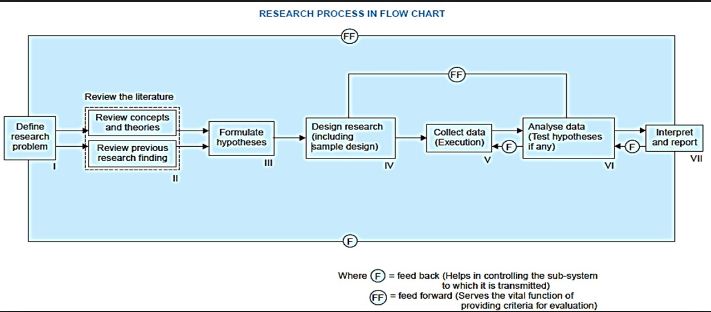
1 Formulating the research problem
-Maybe related to states of nature or relationships between variables
A researcher must single out problem to study and must decide the aura of interest
-Feasibility of a particular solution has to be considered before working on the problem
-Two steps in formulating a research problem: Understanding the problem thoroughly and Rephrasing the same into meaningful terms
-Discuss the problem with experts
Examine available literature both conceptual and empirical
-Reevaluate the problem and focus on its specifics
-Make sure the problem can be defined unambiguously
-State the objective
-Pertinent terms in relation to the problem must be defined
- Extensive Literature Survey
– Brief summary of the problem after the problem is formulated
– Write a synopsis of the topic and submit it to the committee or research board
– Literature survey by abstracting journals and reading up bibliography
- Development of working Hypothesis
– It’s made so as to draw out and test its logical or empirical consequences
Discuss with work colleagues and experts about the problem
– Examine past data and records
– Review similar studies in that area
– Personally, investigate the problem with interested parties
The following are the functions of a hypothesis:
- The hypothesis guides the researcher by delimiting the area of research and to keep him on the right track.
- It sharpens his thinking and focuses attention on the more important facets of the problem.
- It also indicates the type of data required and the type of methods of data analysis to be used.
Determining Sample Design
– the items selected constitute what is called a sample
– Sample design is a plan determined before any data are actually collected for obtaining a sample from a given population
– Samples can either be:
Probability Sample – Each has an element of being included in the sample and are based on Random, Systematic, Stratified, Cluster/Area Sampling.
Non-Probability Sample – Based on Consciences Sampling, Judgement Sampling and Quota Sampling
– Some of the important sample designs are:
(i) Deliberate Sampling
- Purposive or deliberate selection of particular units of the universe for constituting a sample that represents the universe.
- When population elements are selected based on access it’s known as convenience sampling
- Judgment sampling is when a researcher’s judgment is used to select items he considers to be representative of the population
(ii) Simple Random Sampling
- Each and every item in the population has an equal chance of inclusion in the sample and each one has the probability of being selected.
(iii) Systematic Sampling
- An element of randomness is usually introduced into this kind of sampling by using random numbers to pick up the unit with which to start.
- Useful when sample frame is in form of a list
- Selection process starts by picking some random point on the list and then every nth element is selected until the desired number is secured
(iv) Stratified Sampling
- If the population from which a sample is to be drawn doesn‘t constitute a homogeneous group, then stratified sampling technique is applied so as to obtain a representative sample
- The population is stratified into a number of non-overlapping subpopulations or strata and sample items are selected from each stratum.
- If the items selected from each stratum is based on simple random sampling, the entire procedure, first stratification and then simple random sampling is known as stratified random sampling.
(v) Quota Sampling
- When interviewers are simply given quota to be filled from different strata, the actual selection of the items for sample being left to the interviewer’s judgment
- Size of quota is proportionate to size of stratum in the population
- A form of non-probability sampling.
(vi) Cluster sampling
- Grouping of population and then selecting the groups or the groups or the clusters rather than individual elements for inclusion in the sample
- Sample size must often be larger than the simple random sample to ensure the same level of accuracy as in cluster sampling there is a chance of various biases and error
- However, this procedure is relatively easier than others and can be used in the case of personal interviews
(vii) Area Sampling
- Area is divided into smaller non-overlapping areas = geographical clusters and a number of these smaller areas are randomly selected
- Field interviewing is made more efficient through this technique and when there’s no list of the population
(viii) Multi-stage Sampling
- Meant for large geographical areas like an entire country
(ix) Sequential Sampling
Collecting the data
- Various ways – experiment or survey
- Survey methods include – observation, personal interviews, telephone interviews, mailing of questionnaires, schedules
Execution of the project
- It’s necessary to collect adequate and dependable data in a systematic manner and in time
- Careful watch on uncontrollable factors
- Survey must be under statistical control
- Must deal with non-respondents
Analysis of Data
- Categorize raw data
- Coding to transform categorized data to symbols – editing can also be done at this stage
- Tabulation is done to put classified data in form of tables
- Statistical inferences are drawn with the assistance of computers
9. Hypothesis testing
10. Generalization and Interpretation
- If hypothesis is tested and upheld its easy to build a theory
- Triggers new questions in the hypothesis
11. Preparation of the report/ thesis
Finally, the researcher has to prepare the report of what has been researched. Writing of report must be done with great care keeping in view the following parts:
- Preliminaries. This part contains the introductory/formality part. This contains the:
- Content. This part contains the main part of the research study. This contains the:
- End matters. This part presents the mandatory references and attachments such as:
Generic Methocarbamol No Prescription [url=https://cheapcialisir.com/#]buy online cialis[/url] Cialis Sans Ordonnance En Belgique Cialis Cephalexin For Dog No Prescriptions